Preventing the evaporation of water by 90-95 percent and preventing the growth of algae, due to the presence of floating covers inside the tanks or covers on the tank, which in addition prevents the entry of dust from the wind and insects into the tank
They have great tensile strength
They have high resistance to change in length due to heat
They are resistant to strong winds
They have sufficient resistance to aeration in wastewater treatment projects and fish and shrimp farming
Using the minimum possible space to store water in different volumes, even inside indoor halls
The quantity and quality of water in these tanks can be easily measured and controlled on a daily basis
Prefabricated water tanks are completely bolted and easily assembled, disassembled and moved
They have a precise design in terms of shape and high mechanical strength, under the ISO standard
They are offered in different sizes and volumes from 100 to 1775 cubic meters and can be easily installed in the desired location with minimum number of people and in a short time
Capabilities of prefabricated water tanks
Application of prefabricated galvanized tanks
Galvanized prefabricated tanks, which are available in sizes of 50 to 2000 cubic meters, are fully bolted and can be dismantled
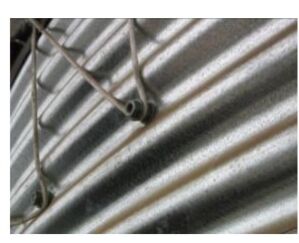
:Tank body
The body of prefabricated tanks is made of high strength galvanized steel (S280GD)
The lifespan of the tanks: 25 years
the height of the tanks is 0.75 meters to 4.57 meters
Inner covers (liners)
The liner of each tank is different according to its application
:Types of liners
1 mm liners suitable for storing drinking water with high resistance to sunlight and repairable with glue
0.75 and 0.5 liners with very high resistance to sunlight and chemicals and suitable for water storage Drinking and agriculture
liners 0.5 mm - PVC - with the possibility of storing food and easy repair
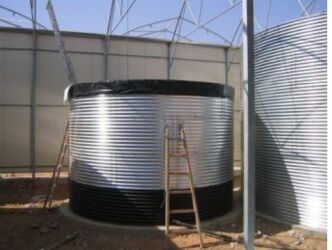
:Anti-algae coatings
Anti-algae covers are used to prevent the growth of algae in the water and to prevent dust from entering the tank
These covers are of two types, which are determined according to the diameter of the tank
:Tensioned AA-Cover
This cover is made of polypropylene and can be supplied in any size, but it is mainly used for tanks with a diameter of about 11 meters
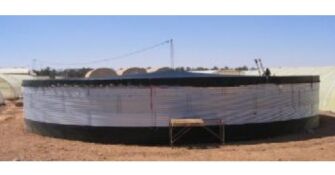
:Floating AA Cover
These covers are used for tanks with high diameters and are placed floating on the tank
The permeability of these coatings to water is 10ltr/m/sec
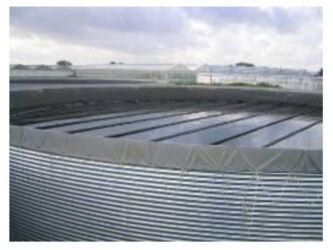
:Tank with metal roof
Recently, in order to ensure the health of stored water, metal roofs are used in prefabricated tanks
Metal roofs increase the cost of tanks. But such tanks with metal roofs are recommended for drinking water
Currently, the maximum diameter that can be used in metal roof tanks is 14.63 and the height is 4.57 meters
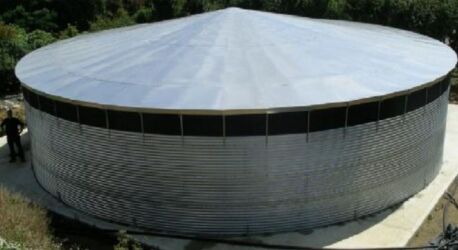
:These tanks can be found in
Greenhouses
factories
sports complexes
flower and plant breeding centers
parks
villages
next to construction projects, etc., and also according to the type of water consumption, both drinking and agricultural water
Comparison of concrete tanks compared to prefabricated water tanks
Concrete tanks are much more expensive than prefabricated water tanks
The installation of concrete tanks requires more time and they cannot be used immediately after construction because the concrete must harden, while prefabricated water tanks are not like that
Prefabricated water tanks can be dismantled and moved, but concrete tanks are not like this, so prefabricated water tankers are flexible
Concrete tanks need a heavier foundation compared to prefabricated water tanks
Due to the presence of hydrogen sulfide in urban and rural wastewater, which causes concrete to crumble, the use of concrete tanks in this regard is not appropriate at all
Concrete bursting, especially in winter, is very important in the concrete structure of storage tanks, sewage treatment plants, transmission lines and water distribution networks
Concrete tanks, unlike prefabricated water tanks, have time (seasonal) and location limitations in construction and installation
Although concrete is a popular and widely used material in construction materials, it also has some weaknesses. Such as low tensile strength, low formability, low energy absorption, shrinkage and shrinkage of concrete, followed by cracks caused by it and finally, cracks caused by improper processing and hardening of concrete (Cracking hardening and curing
Prefabricated galvanized water storage tanks
Subscription
______
Company
______
MBA Business Group

041-33192447
041-33192124


info@mbatradeco.ir
Tabriz.Iran
.No 6,Bahar Av,Valiasr St
سبد خرید